
Heart Rate Zones for Men: How to Train Smarter and Measure Effort

Working harder doesn't always mean training better. Whether you're trying to lose weight, improve endurance, prepare for a race, or simply get healthier, understanding how hard your body is actually working can make every workout more effective. That's where heart rate zones come in—they help you match your effort to your goals instead of relying on guesswork.
Heart rate training has also become far more accessible than it was just a decade ago. Smartwatches, fitness trackers, and connected workout apps now give you real-time feedback during exercise, allowing recreational athletes and beginners alike to train with the same data that endurance athletes have used for years. Learning how these zones work can help you exercise more efficiently while avoiding unnecessary fatigue.
What Are Heart Rate Zones?
Heart rate zones are percentage-based ranges of your maximum heart rate (HRmax) that reflect how intensely your cardiovascular system is working during exercise. Instead of measuring speed, distance, or weight lifted, they measure your body's actual response to physical activity. This makes them useful across almost every form of exercise, from walking and cycling to running, rowing, and interval training.
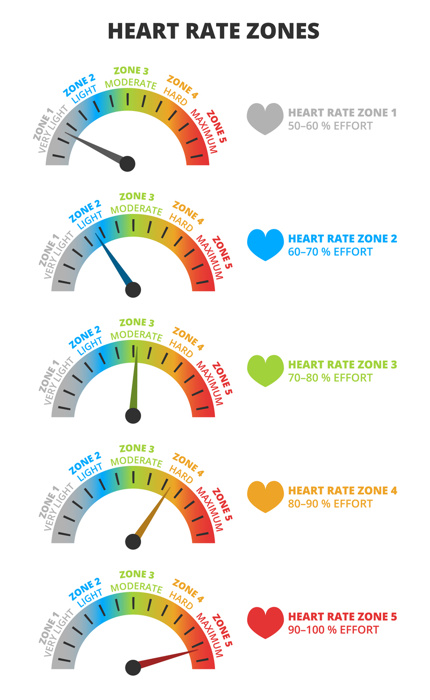
The standard five-zone model progresses from very light recovery work to maximum effort. Zone 1 typically represents 50% to 60% of your maximum heart rate and supports recovery. Zone 2 focuses on aerobic conditioning and forms the foundation of endurance training. Zone 3 develops sustained fitness, while Zones 4 and 5 emphasize threshold work and high-intensity efforts that improve speed, power, and overall athletic performance.
Each zone produces different physiological adaptations because your body relies on different energy systems as intensity increases. Spending every workout at maximum effort may feel productive, but it often slows recovery and limits long-term progress. Understanding the purpose of each zone allows you to train with intention rather than simply exercising as hard as possible every day.
How to Find Your Max Heart Rate for Zone Training
Before you can calculate your training zones, you'll need an estimate of your maximum heart rate. The simplest formula remains 220 minus your age, which provides a quick starting point for most healthy adults. Another commonly used equation, 208 − (0.7 × age), often produces a slightly more accurate estimate because it reflects more recent exercise research.
Keep in mind that these formulas are averages rather than exact measurements. Two men of the same age can have noticeably different maximum heart rates because genetics, fitness level, medications, and overall health all influence cardiovascular performance. Treat your calculated result as a practical guide rather than a fixed limit.
Experienced endurance athletes sometimes determine their true maximum heart rate through supervised fitness testing or laboratory assessments. Most recreational exercisers, however, don't need that level of precision. Starting with an estimated HRmax provides more than enough accuracy for building an effective and sustainable zone-based training program.
How to Check Your Heart Rate Mid-Workout
Knowing your target zone only helps if you can measure your effort during exercise. Today's wearable technology has made that process remarkably simple. Devices like the Apple Watch, Garmin, Polar, Fitbit, and WHOOP continuously monitor heart rate and display your current zone while you train. Chest-strap monitors generally provide the highest accuracy, while modern optical wrist sensors perform well during most steady-state activities.
If you don't own a wearable, manual pulse checks remain an effective alternative. Place two fingers gently on your wrist below your thumb or along the side of your neck. Count your pulse for 15 seconds and multiply by four, or count for 30 seconds and multiply by two. Although this requires briefly slowing down, it still provides a reliable snapshot of your exercise intensity.
Whichever method you choose, consistency matters more than technology. Regularly checking your heart rate helps you recognize how different effort levels feel, making it easier to adjust your pace before you become overly fatigued or accidentally spend too much time outside your intended training zone.

What Each Heart Rate Zone Is Actually For
Every heart rate zone serves a different purpose, and understanding those purposes helps eliminate one of the biggest mistakes exercisers make—treating every workout like a race. Easy sessions, moderate workouts, and intense intervals all contribute to better fitness, but each stimulates different adaptations within the body.
Zone 1 supports recovery by encouraging blood flow while placing very little stress on the cardiovascular system. Zone 2 develops aerobic endurance and teaches your body to use oxygen more efficiently, making it the foundation for long-distance runners, cyclists, hikers, and anyone interested in improving overall fitness. Zone 3 introduces more sustained effort, while Zone 4 challenges your lactate threshold and prepares you for demanding competitions or interval sessions. Zone 5 represents short bursts of maximum effort designed to improve speed, power, and top-end conditioning.
Rather than spending every workout in the hardest zones, many endurance coaches recommend that roughly 80% of weekly training remain within Zones 1 and 2. This balanced approach allows you to recover properly while still building the aerobic capacity needed to support more demanding workouts later in the week.
Why More Men Are Training by Heart Rate Today
Heart rate training has become increasingly popular because modern technology makes it easier than ever to understand your body's response to exercise. Instead of relying solely on distance, pace, or calories burned, many men now use wearable devices to monitor effort in real time. This shift allows workouts to become more personalized, helping beginners and experienced athletes alike avoid training either too hard or too easily.
Fitness platforms such as Strava, Garmin Connect, Nike Run Club, Peloton, and Zwift have also helped normalize data-driven training. These apps automatically record heart rate, pace, recovery, and workout history, allowing users to identify patterns that weren't obvious before. Seeing measurable improvements over weeks and months provides extra motivation while helping people make smarter adjustments to their routines.
The popularity of endurance events, HYROX competitions, recreational cycling, obstacle races, and marathon training has further increased interest in heart rate zones. More men are realizing that successful athletes don't simply push themselves to exhaustion every day—they carefully manage exercise intensity so they can recover well, improve consistently, and stay active for years rather than burning out after a few months.
How to Structure Your Weekly Training by Zone
Building a weekly training plan around heart rate zones doesn't require a complicated spreadsheet or a coach standing beside you. It starts with balancing easy workouts and challenging sessions throughout the week. Many endurance coaches recommend a polarized approach, where roughly 80% of training stays in Zones 1 and 2 while the remaining 20% focuses on higher-intensity work in Zones 4 and 5. This strategy helps improve fitness without creating excessive fatigue.
For most men, a practical schedule might include two or three Zone 2 cardio sessions, one interval workout using Zones 4 or 5, and one or two lighter recovery sessions. Strength training can still fit comfortably into this schedule, but avoid placing heavy lifting and intense cardio sessions back-to-back whenever possible. Giving your body time to recover is just as important as challenging it.
Remember that consistency matters far more than perfection. Missing a workout occasionally won't derail your progress, but constantly training too hard often will. A balanced weekly routine helps you improve steadily while reducing your chances of injury, overtraining, and mental burnout.
Common Heart Rate Zone Mistakes That Hold Men Back
One of the most common mistakes is treating every workout like a competition. Many exercisers assume they must constantly push themselves into the highest heart rate zones to make progress, but this usually leads to excessive fatigue and slower recovery. Easy workouts may not feel impressive, yet they're often where the biggest long-term improvements begin.
Another common issue is relying too heavily on technology without understanding its limitations. Wrist-based sensors occasionally produce inaccurate readings during strength training, sprinting, or exercises involving rapid arm movement. Chest-strap monitors generally provide greater accuracy, but no device replaces paying attention to how your body feels. Heart rate data should guide your decisions rather than control every aspect of your workout.
It's also important to avoid comparing your numbers with someone else's. Two men of the same age and fitness level may have very different resting and maximum heart rates. Progress should always be measured against your own performance, recovery, and consistency rather than someone else's smartwatch screen.
Heart Rate Zones for Fat Loss, Endurance, and Performance
Different fitness goals require different training priorities. Men focused on improving cardiovascular health or building endurance generally benefit from spending most of their time in Zone 2, where the body becomes more efficient at delivering and using oxygen. Long-distance runners, cyclists, and hikers often rely heavily on this type of training because it builds the foundation needed for longer efforts.
Those pursuing fat loss shouldn't assume the highest intensity is always best. Moderate aerobic sessions combined with consistent strength training and proper nutrition often produce more sustainable results than constantly performing exhausting workouts. Meanwhile, athletes preparing for races or competitive sports typically include structured interval sessions in Zones 4 and 5 to improve speed, power, and overall conditioning.
Your goals may also change over time. A beginner trying to improve general health doesn't need the same program as someone preparing for a marathon or HYROX event. Matching your heart rate zones to your current objective ensures every workout supports your progress instead of simply adding unnecessary fatigue.
Conclusion
Heart rate zones give structure to your workouts by helping you understand how your body responds to different levels of effort. Instead of guessing whether you're exercising hard enough—or too hard—you can use measurable feedback to guide your pace, improve recovery, and build fitness more efficiently. Combined with realistic weekly planning and consistent habits, zone training removes much of the uncertainty from exercise.
As wearable technology and fitness apps continue becoming part of everyday life, heart rate training is no longer reserved for elite athletes. Whether you're using an Apple Watch during a morning walk, following a Garmin marathon plan, or tracking rides on Strava, the goal remains the same: train smarter, recover better, and build long-term fitness that supports your health for years to come.